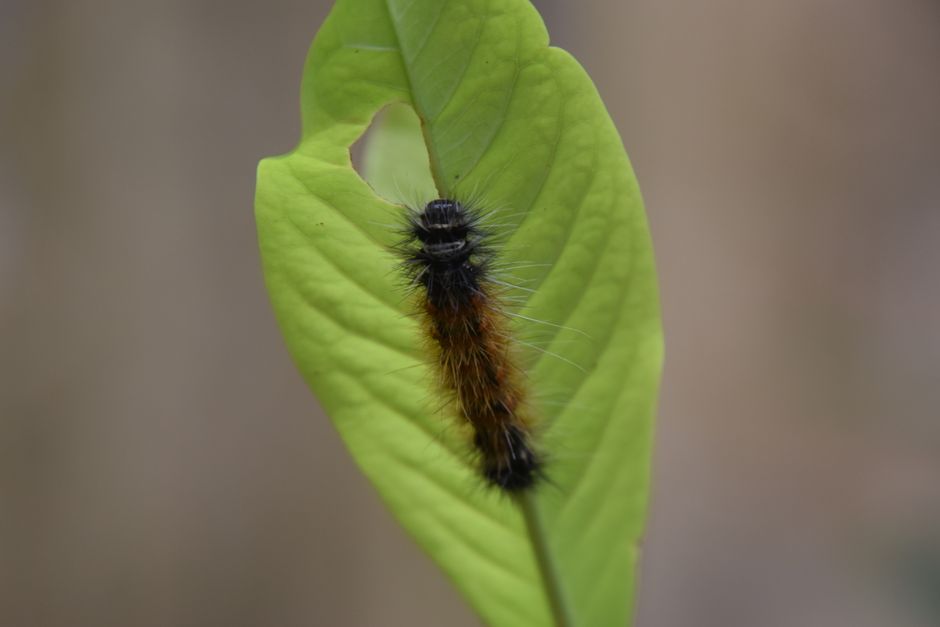
Wired has reported on a study in which researchers placed caterpillars inside an anechoic chamber — a room engineered to absorb sound and eliminate echo almost entirely — in order to investigate how the creatures detect sound despite having no conventional ears. The findings, according to Wired, carry implications not only for the biology of insect hearing but for the future design of microphones.
To appreciate why this is a meaningful piece of research, it helps to understand what makes caterpillar hearing such a persistent puzzle. Most animals that detect sound do so through dedicated structures — eardrums, tympanic membranes, or hair cells arrayed in a cochlea — that convert pressure waves into signals the nervous system can interpret. Caterpillars have none of these. Yet there has been growing evidence over the years that they respond to vibration and airborne sound in ways that cannot be explained by touch or chemical sensing alone. The question of mechanism — what in the caterpillar's body is actually doing the work — has remained stubbornly open. Placing them in an anechoic chamber is a methodologically clever move because it strips away all acoustic clutter, allowing researchers to present precise stimuli and observe responses without interference from reflected sound. It is the kind of controlled environment more commonly associated with aerospace acoustics testing or high-end audio engineering than with entomology, and its use here says something about how seriously researchers are taking the problem.
The broader scientific context is a field that has been quietly expanding its understanding of insect sensory biology for several decades. For a long time, invertebrates were treated as relatively simple sensory machines, responsive to the most immediate stimuli and little else. That picture has been revised considerably. Bees sense the electric fields of flowers. Spiders read the world through the vibrations of their webs. Caterpillars, sitting somewhere in this expanding map of invertebrate perception, seem to be pulling off a version of hearing through body structures — likely fine hairs or the soft tissues of the body wall — that respond to particle motion in the air rather than pressure changes. This distinction matters. Conventional microphones, including the miniaturized ones now packed into smartphones and hearing aids, are predominantly pressure-sensitive devices. They work well in many contexts but have known limitations, particularly at low frequencies and in detecting sounds from specific directions. Biological systems that work on particle motion rather than pressure represent a different engineering solution to the same problem, and one that evolution has had a very long time to refine.
This is where the microphone angle becomes more than a press-release flourish. Researchers and engineers interested in acoustic sensor design have been looking at biological models for some time, a field loosely described as bioacoustic engineering or acoustic biomimicry. The ears of flies in the genus Ormia, which can locate the direction of a cricket's call with extraordinary precision despite having eardrums separated by less than a millimeter, have already inspired experimental microphone designs with improved directional sensitivity. If caterpillars are using a different physical principle to detect sound through their body surface, understanding that mechanism in precise detail could suggest new transducer architectures — ways of converting mechanical energy into electrical signals that do not rely on the same pressure-membrane approach that dominates current manufacturing.
The likely consequences of this research play out on two timescales. In the near term, the findings will matter most to sensory biologists and evolutionary ecologists. Caterpillars that can hear — even in a minimal, poorly understood way — are caterpillars that may be listening for the wingbeats of parasitic wasps or the approach of predatory birds, and that has implications for understanding predator-prey dynamics and the selective pressures that have shaped insect nervous systems. On a longer horizon, if the mechanical basis of their sensing can be characterized precisely enough to be modeled and then fabricated, the engineering applications are genuine rather than speculative. Miniaturized, low-power, particle-motion-sensitive sensors would be of interest to hearing aid manufacturers, drone designers, environmental monitoring networks, and anyone building devices that need to detect sound in conditions where conventional microphones underperform.
What to watch for next is whether the structural findings from this work — whatever specific tissues or appendages the researchers identified as doing the acoustic work — hold up to replication and whether they prove amenable to modeling. The jump from biological observation to manufacturable technology is long and frequently disappoints, but the intermediate step of computational modeling tends to be the first real test of whether a biological mechanism is specific enough to be useful. It will also be worth watching whether the research prompts similar anechoic-chamber studies in other earless insects, since caterpillars are unlikely to be unique in having solved, through some unconventional path, the problem of knowing when something dangerous is coming.