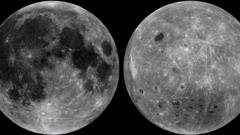
Far Side of the Moon Revealed as Artemis II Crew Completes Historic Lunar Loop
NASA's Artemis II mission has reached one of the most dramatic milestones in human spaceflight, as its crew completed a sweeping loop around the far side of the Moon — the mysterious lunar hemisphere that no human eye has ever directly observed from up close.
The far side of the Moon is a region shrouded in fascination and scientific intrigue. Unlike the familiar near side, it never faces Earth due to a phenomenon known as tidal locking, meaning the Moon's rotation and its orbit around Earth are perfectly synchronised, permanently hiding one face from view.
The landscape of the far side is strikingly different from what Earthbound observers are accustomed to seeing. It is heavily cratered, largely devoid of the vast dark volcanic plains known as maria that dominate the near side, and is home to some of the oldest and most rugged terrain in the entire solar system.
During their passage around this remote region, the Artemis II crew would have experienced a total communications blackout with Earth, a tense but anticipated period during which no signals can penetrate the bulk of the Moon. It is a moment that underscores just how isolated and extraordinary deep space exploration truly is.
Artemis II represents NASA's first crewed lunar mission since the Apollo programme ended more than half a century ago. The mission is designed as a critical stepping stone, testing the systems and procedures that will eventually allow astronauts to land on the lunar surface as part of the broader Artemis programme.
The looping trajectory around the Moon is a carefully engineered flight path intended to stress-test the Orion spacecraft and its life support systems while giving the crew a profound and unparalleled view of our nearest celestial neighbour. It marks a bold new chapter in humanity's return to the Moon.