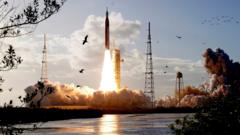
NASA's Artemis II mission has made history, lifting off from Florida in a breathtaking launch that marks humanity's first crewed journey toward the Moon in more than half a century. The momentous blast-off, which has been captured on video and widely shared, signals a new era in human space exploration as the spacecraft now orbits Earth.
The mission, managed by NASA in partnership with international space agencies, represents the culmination of years of development, planning, and anticipation. It is the first time astronauts have been aboard a Moon-bound mission since the final Apollo lunar mission concluded in 1972, making it a landmark moment for both space science and global public interest.
The road to launch was not without its challenges. The mission suffered a series of delays and technical issues that pushed back the original launch schedule, leaving space enthusiasts and the scientific community waiting anxiously for the historic moment to finally arrive.
With the crew now successfully in Earth's orbit, mission controllers will be closely monitoring all systems before the spacecraft proceeds further into its planned trajectory. The Artemis II mission is designed as a crewed flyby, taking astronauts around the Moon and returning them safely to Earth, paving the way for future lunar landings.
The Artemis program as a whole represents NASA's broader ambition to return humans to the lunar surface for the first time since Apollo 17. Beyond national pride, the program is intended to establish a sustainable human presence near the Moon and serve as a stepping stone for eventual crewed missions to Mars.
The successful launch has been met with widespread excitement from the public, scientists, and world leaders alike. For a generation that has only known robotic and remote exploration of the Moon, the sight of humans once again venturing toward Earth's nearest neighbour marks a profound and emotional milestone in the story of human discovery.