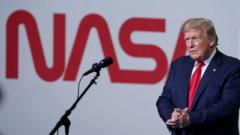
Trump Sees 'America First' Opportunity in Going to the Moon
The United States is once again setting its sights on the Moon, and for the Trump administration, the stakes go far beyond scientific exploration. Experts tell the BBC that a competitive edge over China and the prospect of a lunar resource boom are the twin driving forces behind the Artemis II mission.
The Artemis program, NASA's ambitious initiative to return humans to the lunar surface for the first time since the Apollo era, has taken on renewed geopolitical significance under President Trump. The administration views the mission as a critical component of its broader "America First" agenda, positioning the United States as the dominant force in the emerging arena of space competition.
China has been rapidly accelerating its own lunar ambitions, with plans to land astronauts on the Moon by the end of the decade. Analysts suggest that Washington views this trajectory as a direct challenge to American supremacy in space, making the race to the Moon as much a strategic contest as a scientific one.
Beyond geopolitics, the Moon has increasingly attracted attention for its potential economic value. The lunar surface is believed to contain significant reserves of resources, including helium-3 and rare minerals, fueling speculation about a future lunar gold rush that could have enormous commercial implications.
Artemis II is set to carry a crew of astronauts on a journey around the Moon, marking the first crewed lunar mission in more than 50 years. The mission is widely seen as a foundational step toward establishing a sustained human presence on and around the Moon.
For the Trump administration, the mission represents an opportunity to plant a flag — both literally and figuratively — at the frontier of a new era of space exploration and resource competition. Experts note that whoever establishes early dominance on the Moon may hold significant advantages in shaping the rules and rewards of this emerging domain for decades to come.