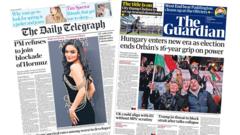
Monday's front pages are dominated by two major international stories, as British Prime Minister Keir Starmer rules out joining a US-led blockade of Iranian ports, and Hungary marks a significant political transition with the election of a new leader.
Several leading newspapers splash with the news that Starmer has declined to commit the United Kingdom to participating in any American-led naval blockade targeting Iran. The decision signals a notable divergence between London and Washington on how best to apply pressure on Tehran, as tensions in the Middle East continue to simmer over Iran's nuclear programme and its broader regional influence.
The stance places the UK in a delicate diplomatic position, as the government seeks to maintain its traditionally close relationship with the United States while also preserving its own foreign policy autonomy. Starmer's refusal to join the blockade effort suggests his administration is opting for a more cautious approach to the Iran question, favouring diplomatic channels over more confrontational measures.
Meanwhile, several papers also give prominent coverage to developments in Hungary, where the election of a new leader marks what many observers are calling the dawn of a new political era for the central European nation. Hungary has long been a focal point of tension within the European Union, particularly during the lengthy tenure of Viktor Orbán, whose government repeatedly clashed with Brussels over democratic standards and the rule of law.
The emergence of new leadership in Budapest has been closely watched across the continent, with EU officials and neighbouring governments alike eager to see whether Hungary's relationship with the bloc will shift under fresh direction. Any change in tone or policy from Budapest could have significant implications for EU cohesion and decision-making.
Together, the two stories reflect a broader theme of political change and realignment playing out across Europe and beyond, as governments navigate an increasingly complex global landscape marked by geopolitical rivalry, shifting alliances, and ongoing regional conflicts. Monday's papers suggest that both stories will continue to generate significant debate and analysis in the days and weeks ahead.