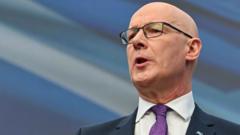
SNP Leader and First Minister John Swinney has expressed confidence that his party will secure a majority government following next month's Scottish Parliament election, predicting the SNP will win at least 65 seats at Holyrood.
Swinney made the bold prediction during an interview with BBC News, setting a clear benchmark for what he considers a successful outcome for the party he leads. A majority at Holyrood requires a party to secure at least 65 of the parliament's 129 seats.
The prediction marks a significant show of confidence from the SNP leader ahead of what is expected to be a fiercely contested election. The party has governed Scotland for over a decade, though in recent years it has faced considerable political turbulence, including leadership changes and ongoing scrutiny over its handling of public services.
Swinney himself took over as First Minister following a period of significant instability within the party, stepping in as a steadying presence with considerable experience in Scottish politics. His leadership has been seen as an attempt to reset the SNP's fortunes ahead of the crucial Holyrood vote.
The SNP has historically championed Scottish independence as its central political mission, and a strong majority result would bolster Swinney's authority both within his party and in any future negotiations with Westminster. Opponents, however, are likely to contest such projections, with Scottish Labour, the Conservatives, and the Liberal Democrats all competing for votes.
The election result will be closely watched not only for its implications on devolved governance in Scotland but also for what it signals about the broader appetite for independence among Scottish voters. Swinney's confident prediction sets the stage for what promises to be one of the most closely scrutinised Scottish Parliament elections in recent memory.